Founded 1353 CE
Wat Phutthaisawan
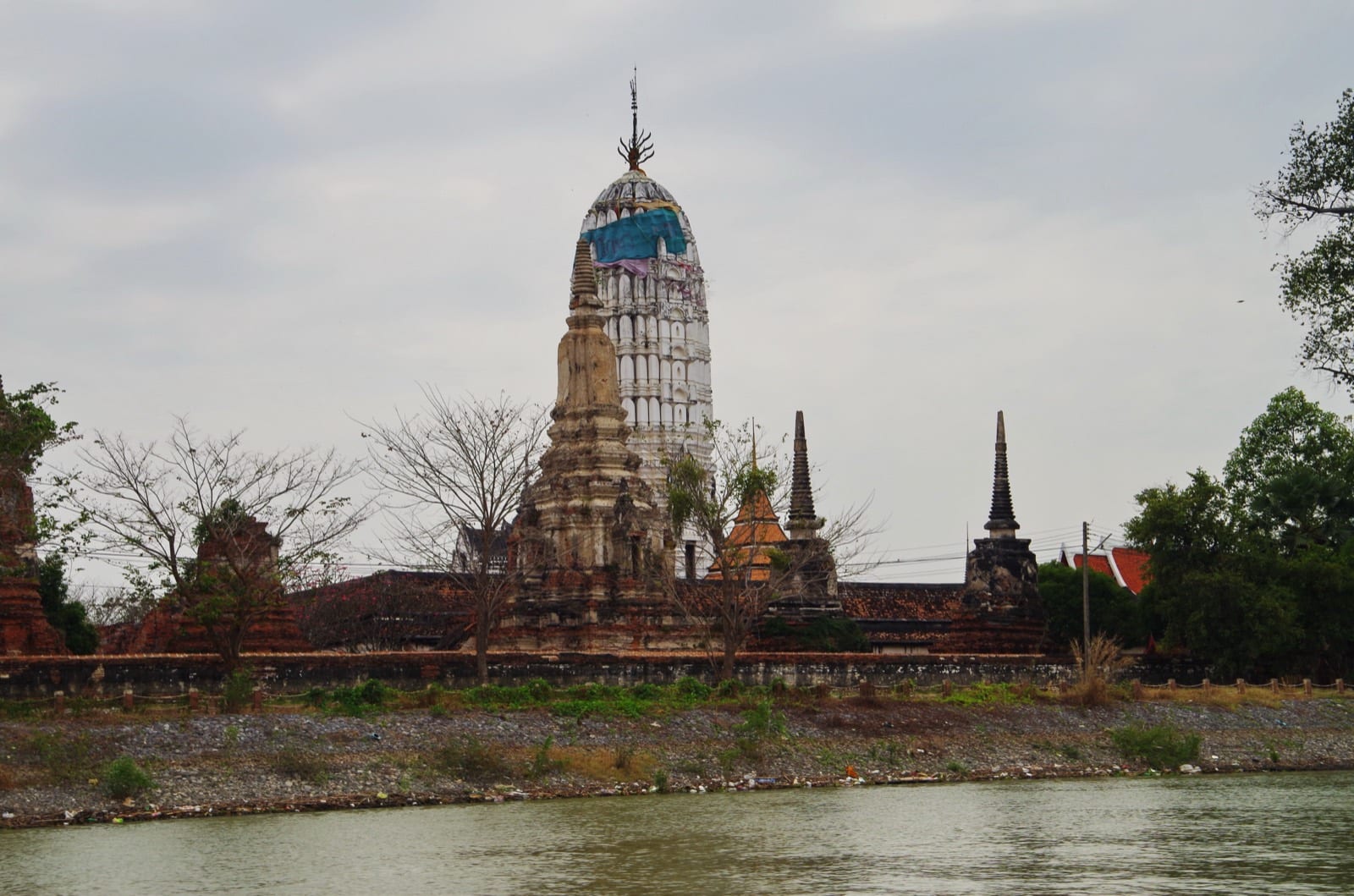
Look to the west bank of the Chao Phraya, across from the southern side of the city island, and you will see a gleaming white central prang rising above its roofed cloister and the riverside trees — a bright, intact landmark on a river of ruins. Tradition holds that King Ramathibodi I (U-Thong), founder of Ayutthaya, raised this royal monastery in 1353 on the ground of 'Wiang Lek,' where he is said to have first settled before founding the capital. Crucially, Wat Phutthaisawan was one of the very few temples to survive the Burmese destruction of 1767 largely intact — which is why its Khmer-style prang, set on a pedestal projecting north and south to evoke Mount Meru, still stands whole today. It is one of the rare places on the loop where you glimpse an Ayutthaya prang as it was meant to look, rather than as a blackened ruin. (Some scholars, following French sources, credit King Narai in the late 17th century, and the standing architecture is mid-to-late 17th-century in style — so the present temple may rebuild an earlier U-Thong foundation.)
The White Central Prang and Its Architecture
The white central prang stands at the heart of the temple, raised in the Khmer manner on a redented pedestal that projects north and south. It evokes Mount Meru, the cosmic axis of Buddhist cosmology, its slender body tapering upward within a square roofed cloister. Along the cloister's inner walls, rows of Buddha images sit on decorated bases, several in the graceful Sukhothai manner and still bearing their gilding.
What sets Wat Phutthaisawan apart from other ruins on the city island is how complete it reads. The prang, the enclosing cloister, and the two subsidiary mandapas that flank it to north and south still stand together as a single composition, where most temples survive only as brick stumps and bare foundations. Here a visitor sees an Ayutthaya prang much as it was meant to appear, whole rather than fragmentary.
King U-Thong, Wiang Lek, and the Founding of Ayutthaya
According to the royal chronicles, King Ramathibodi I, better known as U-Thong and founder of Ayutthaya, first settled at a place called Wiang Lek on the west bank of the river before moving across to raise his capital on the city island in 1350. Some three years into his reign, tradition holds, he founded Wat Phutthaisawan in 1353 on that earlier ground and elevated it to a royal monastery, commemorating the very spot where the dynasty began.
Its standing as a royal foundation gave the temple an enduring importance. An image of King U-Thong was long enshrined within the prang; it survived the destruction of 1767 and was later carried down to Bangkok in 1784. That surviving image ties the monastery directly to the first king who shaped the kingdom.
Surviving 1767 and the Narai-Era Question
Wat Phutthaisawan is among the very few temples to have come through the sack of 1767 largely intact, spared in part by its position off the city island on the west bank, near the old Saint Joseph's Church. Inside survive murals and stucco work, most notably in the Tamnak Phra Phutthakhosachan, a two-storey residence with the boat-hull curved base of late Ayutthaya, painted with Jataka tales and scenes from the Buddha's life. In 1954 gold objects were recovered from a crypt beneath the prang.
Scholars have nonetheless questioned the founding date. Older chronicles such as the Luang Prasoet recension do not mention the temple, and the architecture visible today reads as mid-to-late seventeenth century in style. Drawing on French accounts and maps, some have proposed a rebuilding, or building, in the reign of King Narai. This remains a scholarly conjecture; the present temple may well rebuild an earlier U-Thong foundation on the same ground.
From the River
As a boat glides along the southern edge of the city island on the Chao Phraya, Wat Phutthaisawan appears on the west bank, facing the island's southern side. The tip of the white prang rises above the fringe of riverside trees, a landmark visible from a distance and instantly legible as a complete Khmer-style tower.
In the soft light of morning or late afternoon, the pale stucco catches the sun and stands out against the brown water and the sky, lending the prang a particular grace when seen from the river. It is one of the few points on the island loop where a passenger sees an Ayutthaya prang standing whole, read from the middle of the water.
Did you know
Did you know: because it escaped the torching of 1767, this white prang still stands whole — one of the few points on the loop where you see an Ayutthaya prang as it was meant to look.
Frequently asked questions
When was Wat Phutthaisawan built, and by whom?+
By tradition the temple was founded in 1353 CE by King Ramathibodi I (U-Thong), founder of Ayutthaya, on the ground of Wiang Lek where he had first settled, and raised as a royal monastery. Some scholars, however, argue the standing architecture belongs to a later period.
Why did Wat Phutthaisawan survive the destruction of 1767?+
The temple lay off the city island on the west bank near Saint Joseph's Church, and so came through the fall of the capital largely intact. It is today one of the few temples where the prang and its cloister still stand more or less complete.
What is a Khmer-style prang, and what does it symbolize?+
A prang is a tall, tapering tower of Khmer inspiration. At Wat Phutthaisawan it rises on a redented pedestal projecting north and south, and in Buddhist cosmology represents Mount Meru, the centre of the universe, encircled by a cloister lined with Buddha images.
Can you see Wat Phutthaisawan from the river, and on which bank does it stand?+
Yes. It stands on the west bank of the Chao Phraya, opposite the southern side of the city island; the white prang is visible from midstream. It is one of the stops on Mercury Cruise's island-loop route.
© Supanut Arunoprayote, Wikimedia Commons (CC BY 4.0)