Present church built 1883–1891
St. Joseph's Church
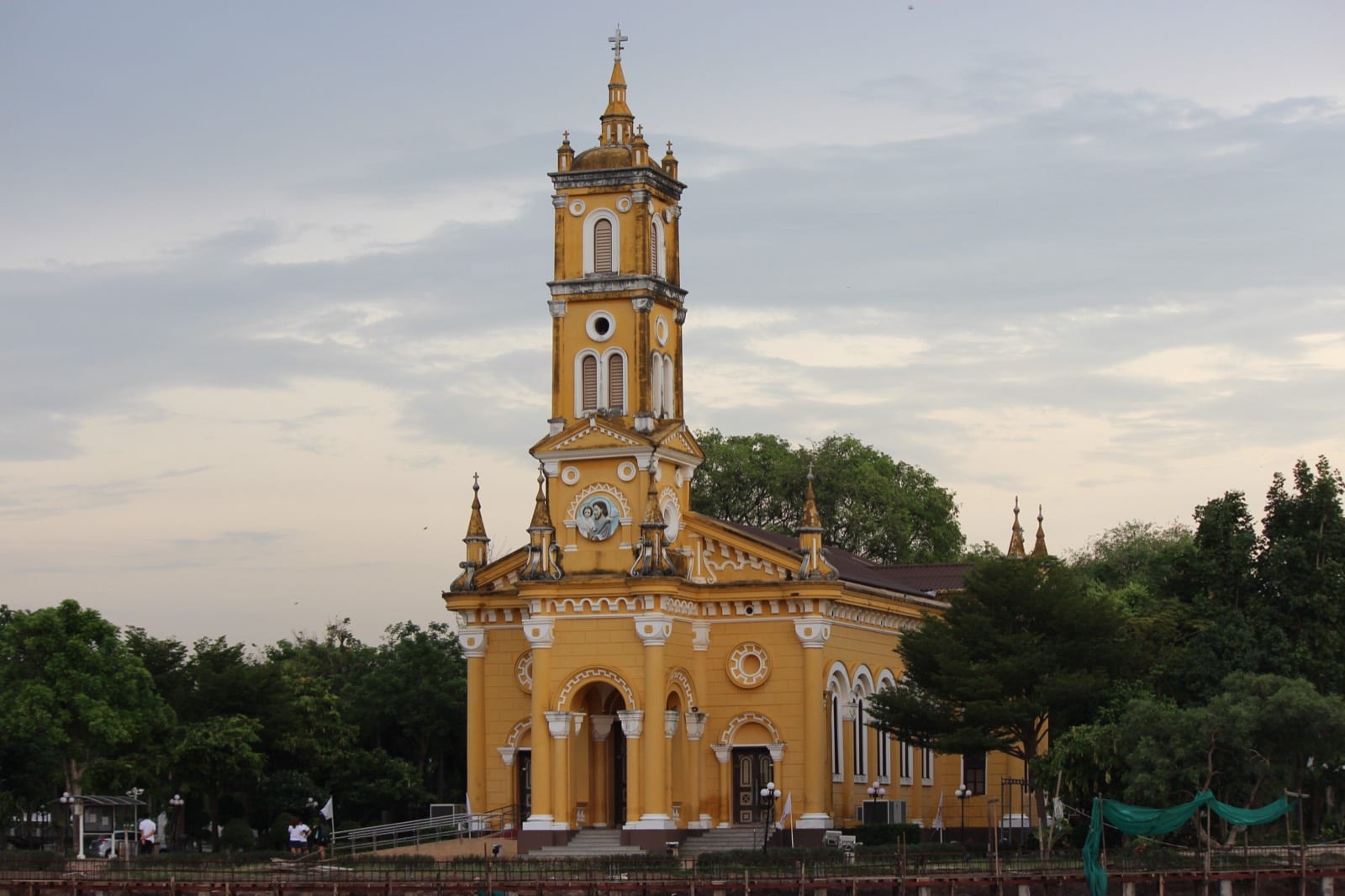
This luminous yellow church is the birthplace of Roman Catholicism in Siam, tracing its origin to a wooden chapel built in 1666 by the French bishop Pierre Lambert de la Motte on land granted by King Narai. Watch for its Romanesque bell tower and symmetrical facade rising almost straight from the bank of the Chao Phraya, designed by the Italian architect Joachim Grassi and completed in 1891. The warm ochre-yellow walls glow vividly against the green riverside, making this one of the loop's most recognizable and photogenic landmarks. It stands in striking contrast to the Buddhist temples that surround it, a vivid marker of a Catholic community that has endured on this exact bank for over 350 years.
The Romanesque Church of 1883–1891 and Its Architecture
The St. Joseph's Church seen today was raised in roughly 1883–1891 to the design of the Italian architect Joachim Grassi, who shaped several notable buildings in the Bangkok of King Rama V's reign; further work in the Romanesque manner continued under Father Perros. The architecture favours a symmetrical facade, rounded Romanesque arches, and a bell tower that rises high above the line of the Chao Phraya's bank.
Its most memorable feature is the warm ochre-yellow render, luminous in strong light and set in vivid contrast to the greenery of both riverbanks. Within, stained-glass windows recount biblical scenes in the European Catholic tradition. Though details have been restored over the years, the whole retains an atmosphere of calm and quiet dignity that endures to this day.
Bishop Lambert de la Motte, King Narai, and the Origin of 1666
The story begins when the Paris Foreign Missions Society (Missions Étrangères de Paris) reached Ayutthaya around 1662, led by Bishop Pierre Lambert de la Motte. King Narai granted the mission land and extended his protection, and around 1665–66 the Seminary of Saint Joseph was founded here as a training centre for clergy across the region.
Narai's openness toward foreigners allowed a Catholic community to take root on this riverbank, and the first wooden church rose as its spiritual heart. For this reason the site is honoured as the cradle of the Catholic Church in Siam, though records differ slightly on the exact years of the land grant and the building of that earliest wooden chapel.
War, Ruin, and Rebuilding Across 350 Years
The first wooden church was rebuilt in brick in the European style between roughly 1685 and 1695. Yet when Ayutthaya fell to Burmese forces in 1767, the church and seminary were plundered and burned to ashes around 23 March. A major restoration began again around 1831 under Father Pallegoix and was completed around 1847, before the present church was raised at the century's end.
The yellow church of today is thus a kind of "fourth chapter" of a story begun on this bank: after the first wooden chapel, the Ayutthaya-era brick church, and the mid-19th-century restoration. More moving than the building itself is the Catholic community that has kept its faith on this riverbank for over 350 years, enduring war and ruin and rising to rebuild time and again.
From the River: What the Cruise Passenger Sees
Gliding along the Chao Phraya around the city island, the eye is drawn to the glowing yellow walls that rise almost from the water's edge. The Romanesque bell tower and symmetrical facade stand out sharply against green foliage and open sky—an unexpected sight amid the surrounding Buddhist stupas and temple roofs.
The church sits on the southern side of the waters that encircle the old island, and its finest hours come in the soft light of morning and late afternoon, when the low sun warms the ochre render and casts its reflection onto the river. For the traveller by boat, it is one of Ayutthaya's most memorable views—three and a half centuries of heritage standing beside the very river the French missionaries once sailed to reach.
Did you know
Did you know? This is regarded as the cradle of the Catholic Church in Thailand — the yellow church you see today is the fourth chapter of a story that began on this very riverbank over 350 years ago.
Frequently asked questions
When was St. Joseph's Church in Ayutthaya built?+
The present church was built around 1883–1891 to the design of Italian architect Joachim Grassi, but a church has stood on this site since about 1666, beginning with a wooden chapel.
Why is the church yellow, and what style is it?+
It is rendered in a warm ochre-yellow that glows in sunlight, and built in the Romanesque style with rounded arches, a symmetrical facade, and a tall bell tower, standing in vivid contrast to the surrounding Buddhist temples.
Who founded this church?+
It was founded by Bishop Pierre Lambert de la Motte of the Paris Foreign Missions Society, on land granted by King Narai—making it regarded as the cradle of the Catholic Church in Siam.
Can I see St. Joseph's Church from a river cruise?+
Yes. Its yellow walls and bell tower rise almost from the water's edge and are clearly visible from the river; it is one of the stops along Mercury Cruise's island-loop route, and looks finest in the soft light of morning or late afternoon.
© Uhooep, Wikimedia Commons (CC BY-SA)