Founded 1630 CE, reign of King Prasat Thong
Wat Chaiwatthanaram
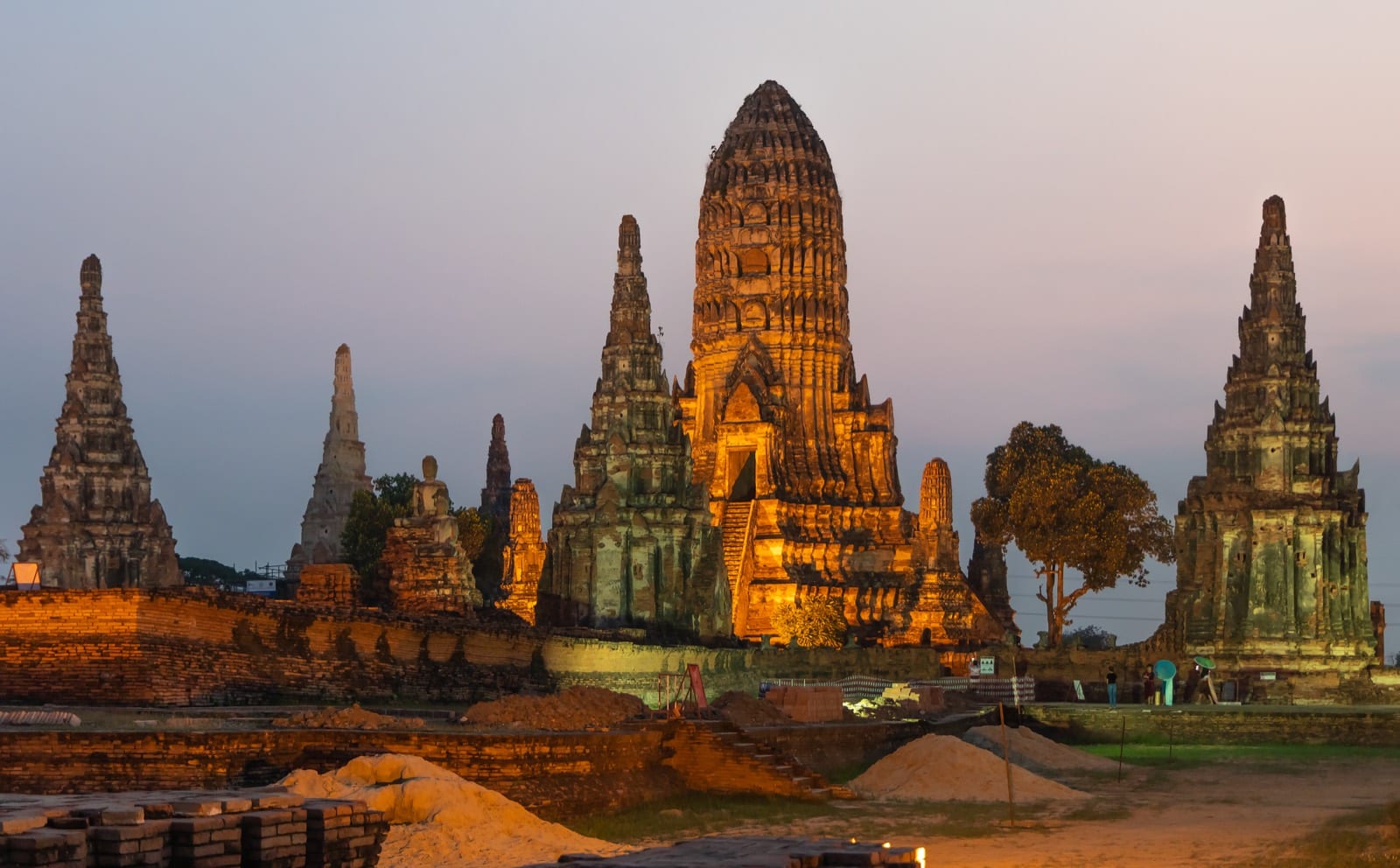
On the western bank of the Chao Phraya, Wat Chaiwatthanaram offers the single most dramatic river view of the entire island loop, its full silhouette turned broadside to the boat with almost nothing to block it. King Prasat Thong raised it in 1630 as the first royal monastery of his reign, on ground linked to his mother's former residence — a gesture of merit that, by reviving the monumental Khmer temple-mountain form, also proclaimed the usurper-king's legitimacy against the prestige of the old Angkorian god-kings. Look for the 35-metre central prang standing for Mount Meru, ringed by four corner prangs and a ring of chedi-shaped chapels, all raised on a broad terrace. When Ayutthaya fell to the Burmese in 1767, the Buddha images lining the cloister gallery were beheaded, leaving the haunting headless silhouettes that remain the temple's emblem. Time your passage for dusk, when the western sky sits directly behind the spires and they blaze gold and rose — the reason this is the prime turnaround point for evening cruises.
The Architecture: A Cosmic Mountain by the Water
At the heart of Wat Chaiwatthanaram rises a central prang roughly 35 metres tall, standing upon a broad terrace as an image of Mount Meru, the axis of the universe in Buddhist and Brahmanic cosmology. Around it stand four corner prangs marking the four continents that ring the cosmic mountain, all set out with the strict symmetry of Khmer architecture, whose temple-mountain form the temple deliberately revived at a time when Ayutthaya had largely set it aside.
Enclosing the terrace is a rectangular cloister punctuated by eight chedi-shaped chapels, known as meru, arranged around the processional court. The gallery once sheltered around one hundred and twenty seated Buddha images in the attitude of subduing Mara, while stucco reliefs along the outer chapel walls recounted scenes from the life of the Buddha. Plan and proportion together were meant to let the pilgrim, walking clockwise, move through a working model of the cosmos.
King Prasat Thong and Why He Raised It
King Prasat Thong founded Wat Chaiwatthanaram in 1630, making it the first royal monastery of his reign; its name evokes a glorious age and a long, victorious rule. Tradition holds that the ground was tied to the former residence of his royal mother, so the temple served at once as a house of merit and as a memorial to her.
Prasat Thong's own path to the throne was regarded by many of his contemporaries as contested. His choice to revive the monumental Khmer temple-mountain form, long associated with the idea of a supreme, world-ordering kingship, can be read as a declaration of authority and legitimacy proclaimed through sheer architectural grandeur, set where it would be seen from both banks of the passing river.
1767, the Headless Buddhas, and the Long Restoration
When Ayutthaya fell to the Burmese in 1767, Wat Chaiwatthanaram was abandoned and plundered. Many of the Buddha images along the cloister were beheaded, some in the search for hidden valuables, some as an act of war, leaving only rows of headless silhouettes in silent procession, an image that has since become the temple's emblem.
The Fine Arts Department began serious restoration around 1987, opening the site to the public early in the following decade. In the great flood of 2011 the monument stood under some two metres of water for weeks. A subsequent Thai–United States conservation partnership, carried out over roughly twelve years, was completed in 2024, returning stability and grace to the towers once more.
Seen from the River
Wat Chaiwatthanaram stands on the west bank of the Chao Phraya, just beyond the city island. As a boat glides along the river, the cluster of prangs reveals itself little by little above the line of bankside trees, composed like a painting. Its main gate faces the water; in earlier days the king arrived by royal barge and entered through this very portal, so the river was never merely a backdrop but part of the temple's ceremonial approach.
In the late afternoon, as the sun sinks behind the towers, golden light warms the brick and the prangs cast their long reflection across the water. This is the hour when Wat Chaiwatthanaram is at its most beautiful, and the reason it has become the natural point at which an evening cruise turns back, closing the loop around the island with an image that stays in the memory.
Did you know
Did you know? In the great 2011 floods the temple stood under some 2 metres of water for weeks — a 12-year Thai–U.S. conservation partnership finished restoring it only in 2024.
Frequently asked questions
How tall is the central prang of Wat Chaiwatthanaram, and how is it laid out?+
The central prang rises about 35 metres on a raised terrace, symbolising Mount Meru. It is ringed by four corner prangs and enclosed by a rectangular cloister set with eight chedi-shaped chapels (meru).
Who built Wat Chaiwatthanaram, and when?+
King Prasat Thong founded it in 1630 as the first royal monastery of his reign, on ground that tradition links to the former residence of his royal mother.
Why are the Buddha images at the temple headless?+
After Ayutthaya fell to the Burmese in 1767, the temple was plundered and many cloister Buddhas were beheaded, some in the search for hidden valuables and some as an act of war, leaving the headless figures that remain the temple's emblem.
Can you see Wat Chaiwatthanaram from a river cruise, and when is it most beautiful?+
Yes. The temple sits on the west bank of the Chao Phraya and its prangs are clearly visible from the water; it is loveliest in the late afternoon near sunset. It marks the turnaround point of an evening cruise and is one of the stops on Mercury Cruise's island-loop route.
© Stefan Fussan, Wikimedia Commons (CC BY-SA)