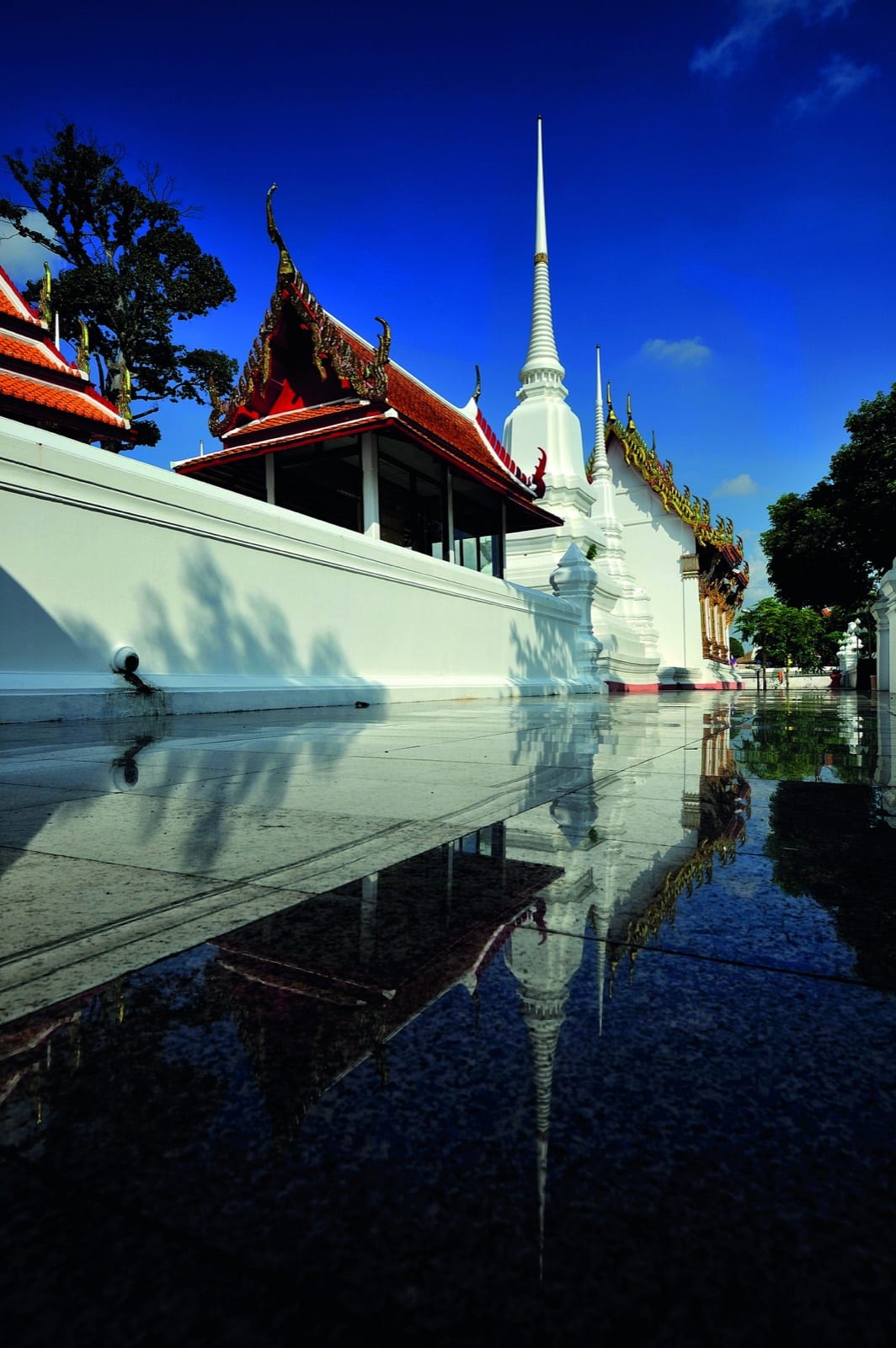
Middle Ayutthaya period (c. 1488–1629) · major restoration in the early Rattanakosin era
Wat Kasattrathirat
On the Chao Phraya's western bank, off the north-western tip of the city island near Ban Pom, look for a whitewashed, living monastery rising just back from the water — not a jungle-swallowed ruin but a temple still humming with monks and daily merit-making. Its signature is the principal prang: notably stout and rounded, visibly heavier and less tapered than the slender classic prangs elsewhere on the loop, and built with no interior stair to the relic niche. Presumed to date from the Middle Ayutthaya period, the temple owes most of what stands today to a thorough early-Rattanakosin restoration under Prince Krom Khun Isaranurak, a nephew of King Rama I. Behind the ordination hall and rounded tower stretches the flat expanse of the Thung Prachet field, framing a lived-in silhouette that reads very differently from the silent royal ruins nearby. Watch the west bank as the boat rounds the island's north-west — the squat, rounded prang is the easy 'odd-one-out' to pick out from the water.
The Stout, Rounded Prang and the Temple Compound
The heart of Wat Kasattrathirat is its principal prang, and it is an unmistakable outlier. Where the classic Ayutthaya prang tapers into a slender, upward-reaching corncob silhouette, this one is thick, rounded and heavy-set, closer to an elongated bell than a spire. It has no interior stair climbing to the relic niche that many prangs conceal, and small bell-shaped chedis sit in the surrounding niches, on plinths where Buddha images are thought once to have stood.
Around the prang runs the wider living compound: a cloister, the ordination hall, and monks' quarters still in daily use. Because nothing here has collapsed into anonymous brick, the plan reads clearly. Several structures are later additions rather than Ayutthaya originals, notably work carried out in the reign of King Rama IV, so the temple is best understood as something that grew in layers over centuries rather than freezing at a single moment.
Middle-Ayutthaya Origins and the Early-Rattanakosin Restoration
Scholars place the temple's founding in the Middle Ayutthaya period, roughly 1488 to 1629 CE, though firm evidence of the exact year or patron has not survived. It was originally known simply as Wat Kasattra. When Ayutthaya fell for the second time in 1767, Burmese forces encamped at nearby Ban Pom, and the monastery was badly damaged and, for a time, abandoned.
Most of what stands today owes its survival to a thorough restoration in the early Rattanakosin era, undertaken by Prince Krom Khun Isaranurak, a nephew of King Rama I (King Phra Phutthayotfa Chulalok the Great). That rebuilding revived the temple and gave it the fuller, more honorific name Wat Kasattrathirat. Later, in the reign of King Rama IV (King Mongkut), further monastic buildings were added, continuing the temple's slow accretion.
A Living Temple Among the Silent Ruins
What sets Wat Kasattrathirat apart from Ayutthaya's famous royal monasteries is not scale or splendour but simple continuity: it never stopped breathing. While many of the great temples became jungle-wrapped brick after the city fell, this one was restored and has carried on its monastic life without interruption. The whitewashed walls, the chanting, and the daily almsgiving are a living thread running unbroken from the Ayutthaya era to the present.
Behind the temple stretches Thung Prachet, a broad, flat field that opens up the sky and lets the compound and its rounded prang stand out cleanly when seen from the river. That riverside setting has long sustained the surrounding community. The temple is therefore not a monument to be viewed so much as a working centre of faith and everyday life for the people of the Ban Pom neighbourhood.
From the River: The Odd One Out on the North-West Bank
As a boat traces the north-western corner of the city island, Wat Kasattrathirat appears on the far bank: white walls and tiered roofs set against the level expanse of Thung Prachet behind. Unlike the bare-brick ruins one sees elsewhere along the river, this is plainly a working temple, and its freshness and life catch the eye.
The easiest way to fix it in memory is the stout, rounded prang. Set beside the slender, tapering prangs that define the classic skyline, it is unmistakably the odd one out. In early light or the soft glow of late afternoon, its pale walls take on a warm golden tone that softens the heavy silhouette, making it one of the loveliest waypoints to watch for from the water.
Did you know
While the great royal temples nearby fell into ruin, Wat Kasattrathirat was never abandoned — it has stayed a functioning monastery straight from the Ayutthaya era to today, which is why it still hums with monks while the royal ruins stand silent.
Frequently asked questions
When was Wat Kasattrathirat built?+
It is thought to date from the Middle Ayutthaya period, roughly 1488–1629 CE, though the exact year and patron are not documented. It was originally called Wat Kasattra before being restored and renamed in the early Rattanakosin era.
How is its prang different from other Ayutthaya prangs?+
The principal prang is thick and rounded rather than slender and tapering like the classic Ayutthaya type, and it has no interior stair to the relic niche. This heavier silhouette makes it easy to recognise from the river.
Who restored Wat Kasattrathirat?+
The major early-Rattanakosin restoration was carried out by Prince Krom Khun Isaranurak, a nephew of King Rama I. It was during this rebuilding that the temple took its fuller name, Wat Kasattrathirat.
Can visitors see Wat Kasattrathirat from the river?+
Yes. The temple sits on the west bank of the Chao Phraya near the north-western tip of the city island by Ban Pom, easily seen from the water by its white walls and rounded prang. It is one of the landmarks on Mercury Cruise's island-loop route.
© Peerapong Prasutr, Wikimedia Commons (CC BY-SA)