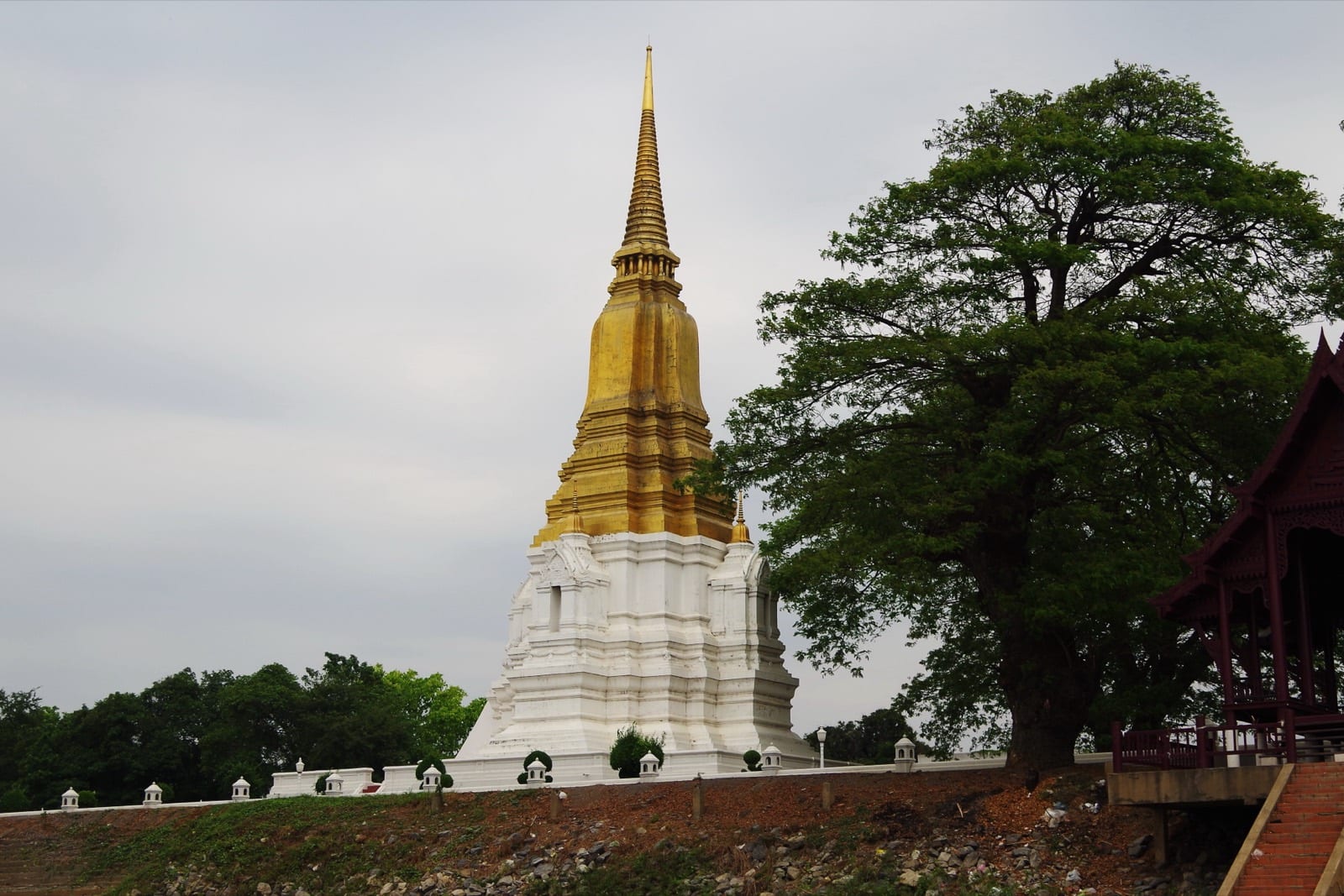
Raised c. 1548 CE — a memorial to Queen Suriyothai's sacrifice
Chedi Si Suriyothai
Look to the western bank of the island and one pale-gold spire stands alone above the Chao Phraya — the Chedi Si Suriyothai, raised to a queen who died to save her king. In 1548 the Burmese king Tabinshwehti marched on Ayutthaya, and Queen Suriyothai, chief consort of King Maha Chakkraphat, rode out disguised in the armour of a viceroy, mounted on a war elephant at her husband's side on the plain of Phu Khao Thong. When the king's elephant faltered and the Burmese Viceroy of Prome bore down on him, she drove her own elephant between them to block the pursuit — and was cut from shoulder to heart by his war-halberd, falling on the elephant's neck together with her young daughter, Princess Boromdhilok. After the war Maha Chakkraphat cremated her here in the royal garden and raised this chedi over the spot, dedicating the ground as Wat Suan Luang Sop Sawan. Its slender, corner-indented tower has been a river landmark ever since.
The Sacrifice of Queen Suriyothai: The Elephant Duel at Phu Khao Thong
The chronicles relate that in 1548, barely six months into the reign of King Maha Chakkraphat, King Tabinshwehti of Hongsawadi marched upon Ayutthaya. The Burmese army advanced in several columns and encamped on the plain north of the capital. When the king rode out to survey the enemy's strength, his chief consort, Queen Suriyothai, disguised herself in the armour and helmet of a viceroy (uparaja) and followed him onto the field upon her own war elephant, accompanied by her daughter, Princess Boromdhilok.
In the melee, the king's elephant faltered and turned in retreat, and the Viceroy of Prome bore down hard behind him. Suriyothai drove her elephant between the two men to shield her husband, and the viceroy struck her with his war-halberd, cleaving her from shoulder to breast. She fell upon the elephant's neck, her daughter mortally wounded at her side. Tradition holds that the viceroy did not know he had fought a woman until her helmet slipped and her long hair fell loose.
The Chedi as Memorial: Wat Suan Luang Sop Sawan
When the war had ended, King Maha Chakkraphat cremated Queen Suriyothai in the royal garden beside the river, and upon the very spot of her cremation he raised a chedi. He dedicated the ground as a monastery named Wat Suan Luang Sop Sawan, a memorial to the loyalty and sacrifice of his consort.
The chedi rises as a slender bell crowned by a tall spire, set upon a base with redented, indented corners in the ordered manner of Ayutthaya art. In 1990 the Fine Arts Department restored the monument and discovered precious relics sealed within, among them a miniature chedi carved from rock crystal, a golden casket, gemstones, and a glass image of the Buddha. These treasures are now preserved and displayed at the Chao Sam Phraya National Museum.
A Heroine's Legacy: From Film to the Spire at Wat Pho
Queen Suriyothai has long been honoured as a heroine of the nation. In 1992 a royal memorial and commemorative park were established at Thung Makham Yong in Ayutthaya province, and in 2001 the director M.C. Chatrichalerm Yukol brought her story to modern audiences in the epic film "The Legend of Suriyothai."
The grace of the chedi itself reached across the centuries. King Mongkut (Rama IV) so admired its form that he took it as the model for the memorial stupa of his own reign at Wat Phra Chetuphon (Wat Pho) in Bangkok, carrying the silhouette of this Ayutthaya monument into the capital, where it endures to this day.
From the River: A Lone Gold Spire Above the Western Bank
As the boat glides along the western edge of Ayutthaya's island, near where the Chao Phraya meets the old city canal (the former Lopburi River), passengers catch sight of a pale-gold spire rising above the line of trees on the bank, lone and serene. It is a river landmark that draws the eye to the very ground where the queen was cremated nearly five centuries ago.
The finest hours are early morning and the approach of sunset, when soft golden light gathers on the chedi and sets it glowing against the sky, its reflection stretching across the water. From the deck of a Mercury cruise, guests take in this quiet view and remember the tale of courage bound to this single, solitary spire.
Did you know
Did you know? King Rama IV so admired this chedi's form that he had it copied as his own reign's memorial stupa at Wat Pho in Bangkok, where it still stands among the four royal chedis.
Frequently asked questions
Who was Queen Suriyothai and why is she important?+
Queen Suriyothai was the chief consort of King Maha Chakkraphat of Ayutthaya. The chronicles relate that in 1548 she disguised herself as a male commander and rode into battle, driving her elephant between her husband and the Viceroy of Prome to shield him, and died on the field. She is honoured to this day as a national heroine of Thailand.
When and why was Chedi Si Suriyothai built?+
King Maha Chakkraphat raised the chedi around 1548 on the spot in the riverside royal garden where Queen Suriyothai was cremated, dedicating the ground as the monastery Wat Suan Luang Sop Sawan in memory of his consort's sacrifice.
How is Chedi Si Suriyothai connected to Wat Pho in Bangkok?+
King Mongkut (Rama IV) admired the form of Chedi Si Suriyothai so greatly that he used it as the model for the memorial stupa of his reign at Wat Phra Chetuphon (Wat Pho) in Bangkok.
Can you see Chedi Si Suriyothai from the river?+
Yes. The chedi stands on the western side of Ayutthaya's island, near where the Chao Phraya meets the old city canal, its pale-gold spire clearly visible above the trees on the bank. It is one of the viewpoints on Mercury Cruise's island-loop route, and is loveliest in the light of early morning and late afternoon.
© Balou46, Wikimedia Commons (CC BY-SA)