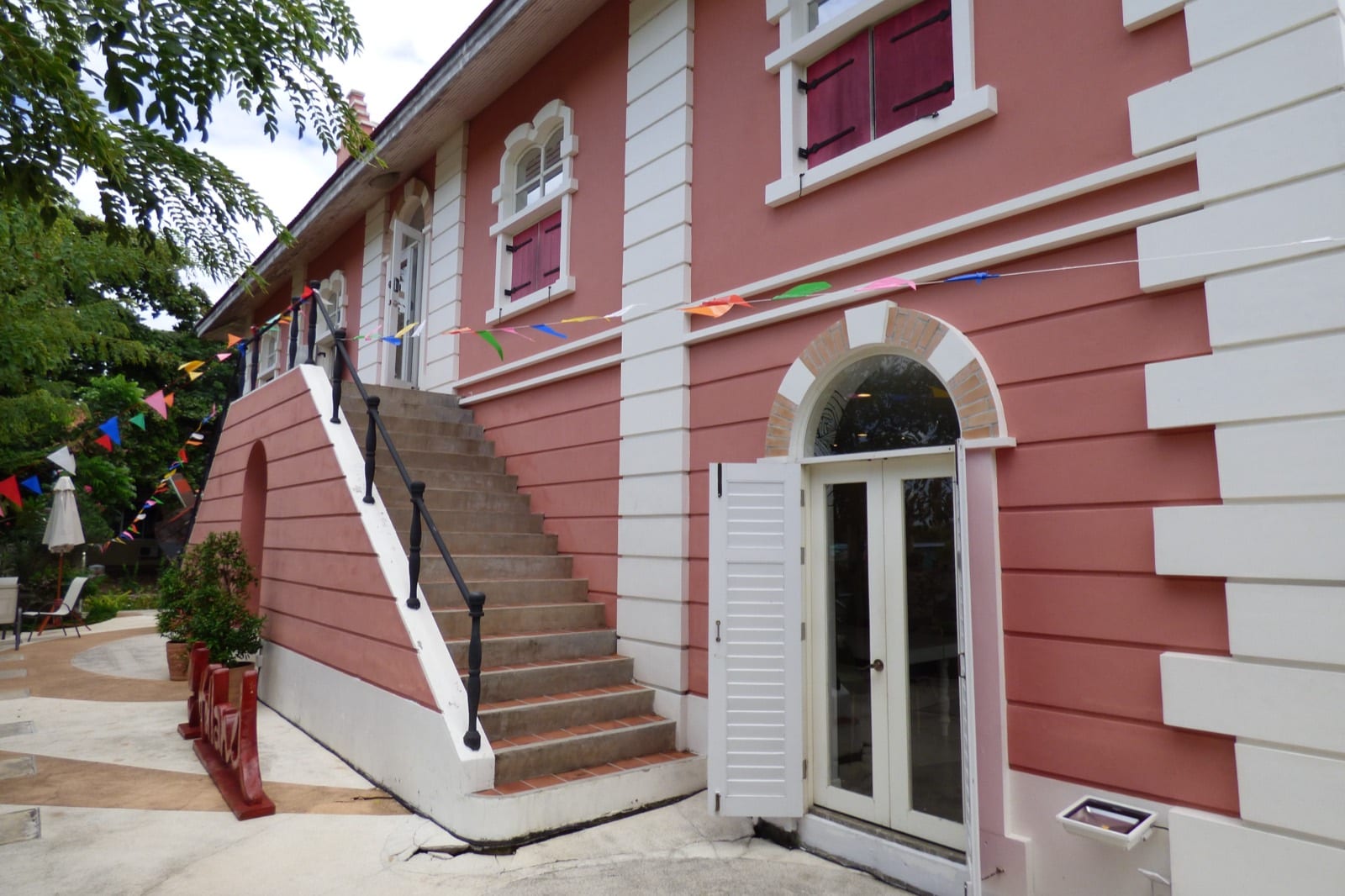
Trade from 1604 · Land granted 1634
Baan Hollanda (Dutch VOC Settlement)
On the southern reach of the Chao Phraya, on the same bank as the Japanese Village and right beside it, watch for an elegant white Dutch-styled museum rising above low courses of old brick. This is the site of the Dutch East India Company (VOC) trading post, granted riverbank land in 1634 and completed as a two-storey brick lodge by 1636 — so distinctive among the town's wooden houses that the Siamese named it Tuek Daeng, 'the Red Building,' reputedly the grandest foreign compound in the kingdom. The Burmese razed it when Ayutthaya fell in 1767, and the present information centre now stands atop the excavated foundations you see from the water. As you glide past, picture the deer-hide and sappanwood trade that once linked this modest bank to Nagasaki and Amsterdam.
The VOC in Siam
Merchants of the Dutch East India Company (the VOC) first reached Ayutthaya around 1604, and by about 1608, in the reign of King Ekathotsarot, they were permitted to open their first trading post in the capital. Siam was then among the busiest crossroads of Asian commerce, and the Dutch steadily grew into the most prominent of the Western traders on the river.
In 1634, under King Prasat Thong, the court granted the Company riverside land for a permanent factory, reportedly in recognition of Dutch naval assistance. A two-storey European brick lodge was completed around April 1636, so unlike the town's wooden houses that the Siamese named it Tuek Daeng, the "Red Building" — long remembered as one of the grandest foreign compounds in the kingdom.
The Trade
The goods that passed through Dutch hands on this bank were the wealth of the forest and the sea: deer and ray skins, sappanwood for a natural red dye, tin, ivory, aromatic eaglewood and more. Deer hides above all were shipped in great quantity toward the eager markets of Japan.
The VOC worked a triangular trade: Japanese silver bought Indian textiles, the textiles were sold in Ayutthaya for hides and sappanwood, and the Siamese goods were carried to Nagasaki for silver once more. So the Company that leaves its name on this quiet bank was one point of a network binding Amsterdam, the Coromandel Coast, Siam and Japan. With that commerce came influence, and the Dutch were a real presence in Siamese court politics — though the relationship rose and fell with the reigns.
Van Vliet, the Fall of 1767, and Baan Hollanda Today
Jeremias van Vliet, who managed the lodge from 1633 to 1642, was more than a trader. He set down the history of Siam in detail, and his chronicle of the Siamese kings is the oldest such account to survive — still consulted by historians as a primary source today.
When Ayutthaya fell to the Burmese in 1767, the Red Building was destroyed with the capital, leaving only old brick courses beneath the soil. In time the Thai and Netherlands governments together raised an information centre, Baan Hollanda, upon the excavated foundations. The graceful white building, opened in 2013, tells the four-century story of Thai–Dutch friendship on the very ground where the trade once stood.
From the River
As the boat drops south of the city island, to where the Chao Phraya swings wide, a passenger catches an elegant white, Dutch-styled building on the eastern bank, rising above a low line of old brick at the water's edge. That is Baan Hollanda — on the same bank as, and right beside, the Japanese Village.
Late-afternoon light warms the white walls against the green of the far bank and the sheen of the river, and it is easy to picture the junks and Dutch sailing ships that once lay at anchor here. From the deck alone, one feels the international crossroads that Ayutthaya once was.
Did you know
The lodge's manager, Jeremias van Vliet (1633–1642), wrote the oldest surviving chronicle of the Siamese kings — still used as a primary source today.
Frequently asked questions
What is Baan Hollanda?+
Baan Hollanda is an information centre and museum on the history of Thai–Dutch relations, built on the excavated foundations of the Dutch East India Company (VOC) trading post beside the Chao Phraya, south of Ayutthaya's city island. It opened in 2013.
Why did the Siamese call the Dutch lodge the "Red Building" (Tuek Daeng)?+
Because it was a two-storey European brick building, completed around 1636, that stood out strikingly among the town's wooden houses. The Siamese named it after that distinctive appearance — Tuek Daeng, the "Red Building."
Why does Jeremias van Vliet matter?+
Van Vliet managed the trading post from 1633 to 1642 and wrote a chronicle of the Siamese kings — the oldest such account to survive. Historians still use it as a primary source for Ayutthaya's past.
Can I see Baan Hollanda by river cruise?+
Yes. Baan Hollanda sits on the eastern bank of the Chao Phraya, the same bank as the Japanese Village, and is clearly visible from the water. It is one of the landmarks on Mercury Cruise's island-loop route around Ayutthaya.
© Paakpoomnoywat, Wikimedia Commons (CC BY-SA)