Land granted 1540
The Portuguese Settlement & San Petro Church
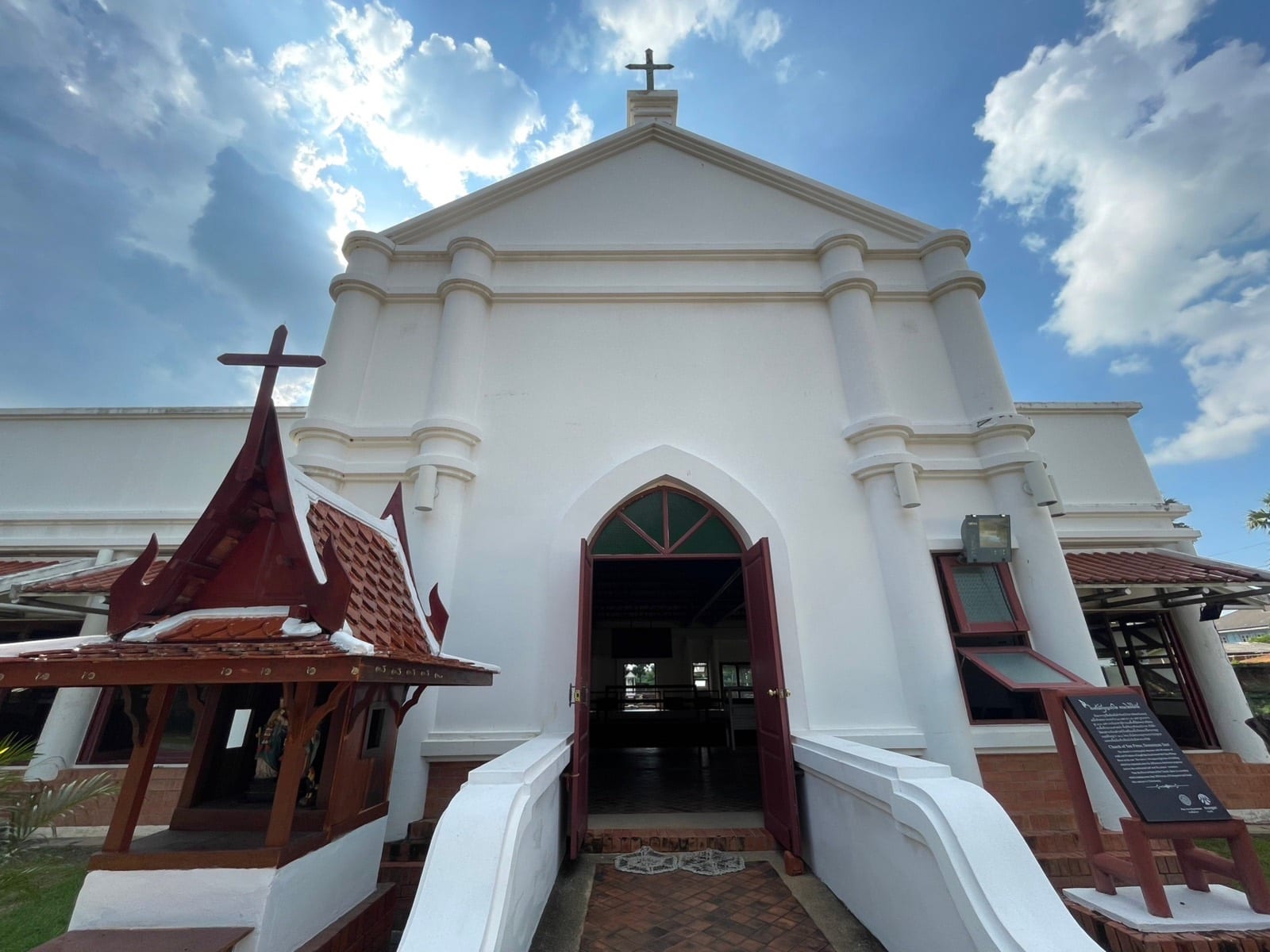
On the southern stretch of the Chao Phraya, on the bank opposite the old Japanese and Dutch quarters, watch for the low riverside archaeological compound of the oldest European community in Siam. The Portuguese were the first Western nation to reach Ayutthaya, in 1511, and in 1540 King Chairacha granted this land to some 120 Portuguese mercenaries, founding a settlement that grew at its peak to an estimated 2,000 households and three rival churches. Its heart is the ruined San Petro (St. Dominic's) church, founded in 1540 and considered the first Christian church in Thailand — now only low brick-and-laterite foundations beneath an open excavation shelter. Set back a short way from the water, that shelter guards more than 250 human skeletons laid out in and around the church, buried alongside coins, rosary beads and crucifixes. This is not a soaring monument but a poignant, ground-level page of history you glimpse from the deck.
The Portuguese in Siam: From Merchants to Musketeers
When Portuguese ships reached Ayutthaya in 1511, soon after their conquest of Malacca, they became the first Western nation to arrive at the Siamese capital. Their carracks carried more than silk and spice: they brought gunpowder, matchlock muskets and a new science of war, prized by a court whose seasons were measured in campaigns.
Around 1540, King Chairacha rewarded some 120 Portuguese mercenaries for their service in war by granting them a stretch of riverbank south of the island city. This gift founded the "Portuguese Village," the oldest European community in Siam. Over the two centuries that followed it grew steadily, said to number several thousand souls before the fall of Ayutthaya in 1767.
San Petro Church and the Excavated Graves
The heart of the village was San Petro, the Dominican church, believed to date from the community's earliest years and counted among the first Christian churches in the Thai land. Dominican friars reached Ayutthaya in 1567 to carry out their mission. The church, of brick and mortar, faced east toward the river; today only its low foundations survive, sheltered beneath a protective roof raised by the Fine Arts Department.
Excavations between 1984 and 1995, supported by the Calouste Gulbenkian Foundation, revealed more than two hundred human burials laid in rows within and around the church. Many were interred with coins, rosary beads and crucifixes, quiet tokens of faith. Those buried here were not Portuguese alone but also mestizos and Siamese converts. Princess Galyani Vadhana opened the site to the public in 1995.
Trade, Faith and a Lingering Legacy
The Portuguese community did not live by faith alone; it was rooted equally in trade and in war. Many of its men served as gunners and royal guards, and they married Siamese, Japanese and Mon women, forming a mixed community with a culture and speech of its own. Though the friars won few Siamese converts, Portuguese influence seeped into daily life in unexpected ways.
The sweetest of these legacies is surely the dessert tray. Maria Guyomar de Pinha, known in Thai as Thao Thong Kip Ma, a woman of Portuguese, Japanese and Bengali descent born in Ayutthaya in 1664, oversaw the royal kitchens under King Narai. She is remembered for popularising the golden, egg-and-sugar sweets, foi thong, thong yip and thong yot, adapted from Portuguese confections. Some research indicates that at least foi thong and thong yip can be most confidently traced to her own hand.
Seen from the River
If the temples and towering prangs of the island are grandeur reaching for the sky, the Portuguese Village is a stillness pressed flat against the earth. As the boat glides along the Chao Phraya south of the old city, passengers see only low brick mounds and a sheltering roof set in an open riverside clearing on the western bank, across from the quarters that once belonged to the Japanese and the Dutch.
In that contrast lies a quiet beauty. There is no spire to crane the neck toward here, only the foundations of a church and its ancient graves, a reminder that strangers from far away once lived, prayed and were laid to rest in this soil. The river that once carried Portuguese carracks up to the capital still flows, unchanged, past their silent cemetery.
Did you know
Golden Thai palace sweets like foi thong and thong yip trace straight back to this riverbank — carried into the royal kitchen by Maria Guyomar de Pinha, a Luso-Japanese-Bengali woman born in Ayutthaya in 1664 who ran King Narai's royal kitchens.
Frequently asked questions
How old is the Portuguese Settlement in Ayutthaya?+
The riverside land was granted around 1540, during the reign of King Chairacha, making it the oldest European community in Siam. The Portuguese had first reached Ayutthaya even earlier, in 1511.
What are the skeletons excavated at San Petro Church?+
Excavations between 1984 and 1995 uncovered more than two hundred human burials laid within and around the church, many with coins, rosary beads and crucifixes. Those buried included Portuguese, mestizos and Siamese converts; some remains are now displayed in situ beneath a protective roof.
Why are Thai golden desserts linked to the Portuguese Settlement?+
Thao Thong Kip Ma (Maria Guyomar de Pinha), a woman of Portuguese, Japanese and Bengali descent born in Ayutthaya in 1664, ran King Narai's royal kitchens. She is credited with popularising egg-yolk-and-sugar sweets such as foi thong, thong yip and thong yot, adapted from Portuguese confections.
Can you see the Portuguese Settlement from the river?+
Yes. The Portuguese Settlement sits on the western bank of the Chao Phraya south of the island city, a low archaeological site hugging the shoreline in contrast to the soaring prangs within the walls. It is among the sights Mercury Cruise passes on its island-loop route around Ayutthaya.
© Anderson, Wikimedia Commons (CC BY-SA)