Founded 1324 CE — 27 years before Ayutthaya
Wat Phanan Choeng
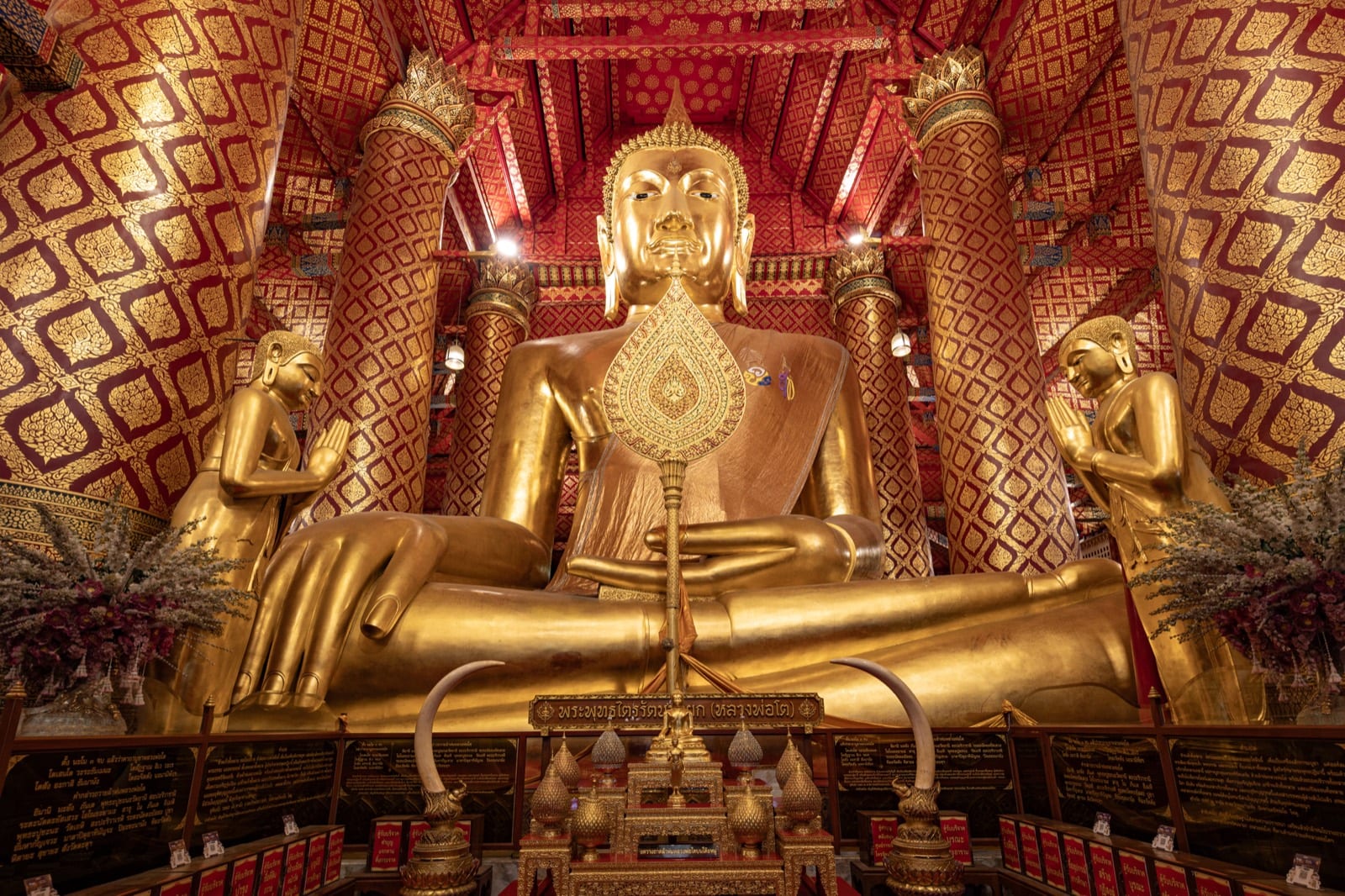
Where the Chao Phraya meets the Pa Sak at the island city's south-eastern corner, Wat Phanan Choeng rises straight from the water's edge, facing the tip of old Ayutthaya. Watch for its tall white wihan and tiered gilded roofs breaking the skyline above the riverbank. Within sits Luang Pho To (Phra Buddha Trai Rattana Nayok), a colossal seated Buddha in the Subduing Mara posture — roughly 19 metres tall with a lap span near 14 metres, and among the largest such images in Thailand, cast in 1324, twenty-seven years before Ayutthaya was founded. Red-and-gold Chinese shrines and lanterns stand beside classic Thai architecture, a legacy of centuries of Thai-Chinese devotion. In 1407 the Ming admiral Zheng He is recorded to have paused here to honour the temple during his great voyages.
Luang Pho To — the colossal Buddha at the water's edge
The heart of Wat Phanan Choeng is Luang Pho To — formally Phra Buddha Trai Rattana Nayok — a colossal stucco Buddha in the Subduing Mara posture, roughly 19 metres tall with a lap some 14 metres wide. Built of brick and mortar and gilded all over, it fills its assembly hall almost to the ceiling and ranks among the largest and oldest seated Buddha images in Thailand. Boatmen have long revered it as a guardian of river travel, stopping to pay their respects before setting out.
Legend holds that just before Ayutthaya fell to the Burmese in 1767, tears flowed from the image's eyes down to its navel, as if it wept for the doomed capital. King Rama IV had it thoroughly restored in 1854 and bestowed its formal name, Phra Buddha Trai Rattana Nayok.
The legend of Chao Mae Soi Dok Mak and the temple's name
The name 'Phanan Choeng' carries two stories. One is bound to the tragic romance of Chao Mae Soi Dok Mak. As the legend goes, a Chinese emperor gave his daughter in marriage to King Sai Nam Pheung of Ayutthaya, but when her boat arrived he did not come down to receive her in person; heartbroken, the princess held her breath and died on this very bank. The king raised a shrine in her memory — believed by many to be the origin of the temple's name.
A second explanation is linguistic: from Khmer, 'phanaeng' means to cross or interlace and 'choeng' means foot — together evoking the Buddha seated cross-legged. To this day the Chao Mae Soi Dok Mak shrine within the temple draws visitors seeking blessings in love and career.
Thai-Chinese devotion and the visit of the Ming fleet
Wat Phanan Choeng embodies a Thai-Chinese devotion rooted on this riverbank for more than seven centuries. Thai-Chinese worshippers revere Luang Pho To as 'Sam Po Kong' — the same name given to the Ming admiral Zheng He — so red-and-gold Chinese shrines, lanterns and drifting incense stand in easy harmony beside classic Thai architecture.
The chronicles record that in 1407 the Ming treasure fleet, on its second great voyage, called at Ayutthaya, and offerings were made to the temple in a ceremony joined by the Siamese court. (Some historians hold that the visitors were more likely officers of Zheng He's staff than the admiral himself.) For this reason Chinese pilgrims from around the world still make their way here in an unbroken stream.
From the river — what to look for from the boat
From the water, Wat Phanan Choeng is a key marker at the south-eastern corner of the island, right where the Pa Sak River flows into the Chao Phraya. Look for the tall white assembly hall and its tiered gilded roofs breaking above the riverside trees, with a cluster of red-and-gold Chinese shrines lining the bank.
The finest hour is late afternoon into dusk, when golden light washes over the hall's roofs and glances off the water. Come during Chinese New Year or a major worship day and you'll find the river and grounds especially thronged — a living devotional energy that sets this temple apart from the silent ruins elsewhere on the loop.
Did you know
Did you know? Chinese devotees call the great Buddha 'Sam Po Kong,' and legend says that just before Ayutthaya fell in 1767, tears flowed from its eyes down to its navel — as if the image itself wept for the doomed capital.
Frequently asked questions
How tall is the Luang Pho To Buddha at Wat Phanan Choeng?+
Luang Pho To (Phra Buddha Trai Rattana Nayok) stands about 19 metres tall with a lap roughly 14 metres wide — one of the largest stucco Buddha images in the Subduing Mara posture in Thailand.
When was Wat Phanan Choeng built?+
By tradition it was founded in 1324 CE, about 27 years before Ayutthaya itself — making the temple older than the capital beside it.
Why do Chinese devotees call the Buddha 'Sam Po Kong'?+
Thai-Chinese worshippers call the image 'Sam Po Kong,' the same name given to the Ming admiral Zheng He — reflecting deep Thai-Chinese ties and the tradition of the Ming fleet's visit in 1407.
Can you see Wat Phanan Choeng from a river cruise?+
Yes. Wat Phanan Choeng sits right on the water at the confluence of the Pa Sak and Chao Phraya rivers, on the island's south-eastern corner, making it one of the most visible landmarks from the boat — especially in evening light. It is a key stop on Mercury Cruise's island-loop route.
© Mastertongapollo, Wikimedia Commons (CC BY-SA)